Monday, January 9, 2012

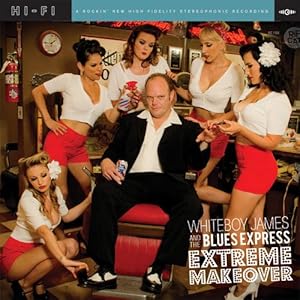
Extreme Makeover reviewed by Harmonica Joe Poluyanskis

Extreme Makeover
Whiteboy James And The Blues Express
www.ripcatrecords.com www.whiteboy james.com
12 tracks/40:20

Rip Cat Records 2011 release of Whiteboy James and the Blues Express’ new CD, “Extreme Makeover”, is a very exciting project. Having been around the West Coast blues scene in the 1980”s and 90’s this band carries on in the styles of Rod Piazza, James Harmon, Hollywood Fats and William Clarke. The Blues Express Band with James has a really big sound and feel to their music presentation. After an absence from the music scene the band reformed with a different bass player and drummer. “Extreme Makeover” is a new rendition of the band’s debut album from 1992. This CD features Whiteboy James on harp and vocals, Scott Abeyta playing guitar, Blake Watson on bass and Max Bangwell. This is an appropriate name for a drummer.

This recording contains a varied mix of 10 tunes penned by Whiteboy James plus “I’m Ready” from Willie Dixon and “Stay Out Late At Night from I. Turner. This is really a good mix of tunes with something for everyone. Right out of the wrapper we get treated to an example of James’ harmonica skill on “Big Butted Women”. He has that electric blues tone and phrasing that defines the blues harmonica. Abeyta’s guitar work also stands out on this tune. The Blues Express band carries with it a big rich blues sound that is very ear grabbing. WB James’ lyrics on “Big Butted Women” are of that racy type that gets your attention right now. James is telling the story as he wants it told. This track does a fine job of showcasing Abeyta’s guitar playing as well as having James doing a great job with his harp solo. Good tune.

“Gold Brick Box” is one of my favorite tracks to listen to on “Extreme Makeover”. Scott Abeyta walks us into the tune with some powerful guitar playing and just continues doing so throughout the entire song. Here we have an example of Scott’s creative, none predictable solid guitar style. James’ vocals are full of a very confident swagger that will draw you into his lyrics on this track. “Slow Down And Let Me Love You” is another song that features WB James’ harmonica playing. Here we have some more real blues harp without any fluff and over playing. James’ ability to pen great lyrics along with the bands very solid blues sound makes real quality blues.

Whiteboy James And The Blues Express’ CD, “Extreme Makeover”, is an example of a fine recording that is upbeat and exciting. This project features a band that is not afraid to play the blues for us. With a solid bass line and drum beat backing James’ vocals and Abeyta’s guitar there are not any clunkers on “Extreme Makeover”. I do wish that WhiteBoy James would have added more of his harp playing. As the Willie Dixon tune goes, “I’m Ready”, ready to hear more of Whiteboy James And The Blues Express.

Reviewed by Harmonica Joe Poluyanskis

Unconditional reviewed by Rick Davis

Unconditional
Ana Popovic
Eclecto Groove Records
www.anapopovic.com
12 Tracks

It has been over two years since Ana Popovic has returned to the studio after her last studio recording Blind For Love in July of 2009. Popovic is considered world wide as one of the best female contemporary blues guitarists performing today. Having seen her perform live, I would concur with that statement! Since she was introduced to a wide variety of music at young age growing up in Serbia, she always delivers a perfect blend of rock, jazz, and soul with blues as the foundation for of all her music. Some of today's contemporary blues has fused traditional blues and rock giving us the best of both music worlds that we have cherished for years.

Unconditional, Popovic's new release, gives listeners more of a traditional blues sound than her previous studio recordings. The album was recorded at the famous Piety Street recording studios in New Orleans working with grammy-winning producer John Porter. It was her intention to capture that New Orleans musical tradition so famous in the Louisiana Delta.  Included on the CD are tunes made famous by some Ana's favorites, including Koko Taylor, Buddy Guy, Otis Spann, Nina Simone and Sugar Pie DeSanto. She either wrote or co-wrote with Mark van Meurs eight of the twelve cuts on this new CD. She was joined in the studio by an all-star cast of New Orleans' finest musicians such as famed slide guitarist Sonny Landreth, Jon Cleary and David Torkanowski on Hammond B3 and piano, Calvin Turner on bass, and Doug Belote on drums. Also included as a guest on the album is extraordinary harp player Jason Ricci. This collection of blues opens with a very roots oriented tune "Fearless Blues" demonstrating superb acoustic guitar and keyboard accompanied by rich background vocals. The hard driving number "Count Me In" combines the fiery guitar of Popovic and the explosive harp of Jason Ricci to take your pulse to the edge. The title track "Unconditional" is a masterful blend of slide guitar and keys with Ana reminding us of the unconditional love displayed "back in the day" delivered in her sultry voice. This is followed by an extremely soulful tune "Reset Rewind" a reflection of life. "Slideshow" is the Popovic/Landreth slide guitar shootout extravaganza that I could only imagine as a live performance on the banks of the Delta! "Business As Usual," also co-written with Mark van Meurs, is another soulful blues tune about a couple who has fallen into the daily routine of life, losing their passion for each other. She begins a guitar solo midway in the song and slowly builds to a blistering, explosive finish towards the end. Ana offers a little caution on "Your Love Ain't Real" as she begins with a subdued, sultry voice and ends up with a powerful delivery of her message. The Nat Adderley/Oscar Brown Jr. tune "Work Song" is a high energy arrangement with world class guitar solos by Ana. "Summer Rain" starts out with a funky rhythm guitar and continues with smooth vocals by Ana, harmonizing background vocals, and a strong guitar finish. Ana's vocals and slide guitar version of  KoKo Taylor's "Voodoo Woman" combined with New Orleans style drums will send you to Congo Square and put a spell on you! Popovic closes with a slow traditional Mercy Walton song "One Room Country Shack" followed by the McAlister/Vail classic blues tune "Soulful Dress" covered also by blues female artists Sugar Pie DeSanto, Marcia Ball, and recently by Maria Muldaur.

''The title Unconditional,'' Ana says, ''describes what I feel on stage. That place is simply unconditional. It is magical. It's just me and my guitar, notes, sounds and drum grooves. I let the band lift me up, and I feed off of their energy. I hate to think when playing. I only feel. Unconditional is how I stand towards my music - it's mine, it's sacred, and it's with no boundaries - absolute, definite. I tend to put everything I have into it and don't let anything or anyone get in between, except the people that truly inspire me.'' This new release is a masterpiece showing the versatility of both Ana Popovic's vocals guitar expertise.

Reviewed by Rick Davis

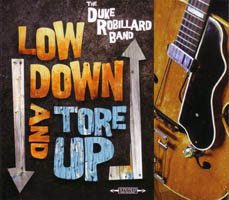
Low Down and Tore Up reviewed by David Stine

Low Down and Tore Up
Duke Robillard Band
Stony Plain Records
www.stoneyplain
records.com
14 tracks/49:13

Duke Robillard can be likened to your favorite chain restaurant; he’s tasty, consistent, and even though his “menu” might change slightly from “meal” to meal, you know, pretty much beforehand what you’re going to be tasting. The only difference is Duke doesn’t tour much so he’s not everywhere. The Duke Robillard Band’s latest, Low Down and Tore Up, stays pretty much true to his established format: jump blues with some Chicago style thrown in with Duke on guitar and vocals, Bruce Bears on piano, Brad Hallen on bass, and Mark Teixeira on drums. Sidekick Sax Gordon adds tenor and baritone sax parts on all but thee cuts.

The disc starts with Eddie Jones’ (AKA Guitar Slim) “Quicksand.” Here we have a nice walking blues with interplay between guitar, sax and piano. No surprises, but if you’re a Duke fan do you really want any? The tempo picks up a bit for Eddie Taylor’s “Trainfare Home”; more piano, more sax and Duke’s signature fat guitar sound. There’s a nice “Got My Mojo Workin’” break in the middle.  The next cut is titled “Mercy Mercy Mama,” another gem unearthed by Duke who is the master of little known blues finds. The standard blues framework is augmented with Bears’ New Orleans style piano giving the song a nice twist. “Overboard,” another find, is a great jumpin’ collision of vocals, sax and piano. If you can just sit and listen to tune you must be in a coma! Great fat guitar from Duke. This is where he lives and breathes, that sound that came out of guitars right after the big bands when venues and orchestras got smaller and smaller. The band slows it down, thankfully, for Pee Wee Crayton’s “Blues After Hours.” More tasty riffs from Duke and low down piano and standup bass. The drums are barely there. Oh yeah!  Bartender, another drink please. Ready to boogie? John Lee Hooker’s “Want Ad Blues” is next. The signature one-chord romp is here with some added stops. Not known for his licks, any Hooker tune is wide open for interpretation by others. Duke does a nice job of staying true to the original and yet slapping his signature on this tune and yes, you can hear some John Lee in the guitar riffs. Dave Bartholomew might not be a common name to those who don’t travel to New Orleans, but he’s a giant among giants in that town. Duke’s rendering of Bartholomew’s’ “Do Unto Others” adds to Duke’s desire to expose lesser-known songwriters to his audience. Jimmy McCracklin, too, is not a household name but Duke’s take on “It’s Alright” might change all that. Yes, more formula here: sax, piano, jazzy guitar, and Duke’s bitten-off vocal phrasing. Remember, you came here for consistency. Song nine is  Marcia Ball’s “Play With Your Poodle.” With less pounding piano, the listener is forced to pay more attention to the lyrics and coming from a male, this song is much more, well, suggestive. From the Elmore James vault comes “Tool Bag Boogie,” another swinging tune allowing Bear and Gordon to step into the spotlight. “What’s Wrong,” again, is a nice find. The “Hoochie Coochie Man” riff meets Duke’s big band sentiments somewhere in New Orleans. That’s my description and I’m sticking to it! “I Ain’t Mad At You” might be familiar to you but what stands out here, and throughout the disc is how much Duke can do with a small cast. You swear you’re enjoying a 10-11 piece band. Nice. Another in the “low down” bracket is the funny/sad “The 12 Year Old Boy.” Where does he find these things? The disc ends, as it began, with another Guitar Slim tune: “Letter For You Baby.”

The disc ends, as it began with the ensemble doing what it does best, deliver that the guests ordered: taste, consistency and satisfaction. Duke is productive, but he doesn’t change it up much. Maybe this is the secret to his success. Happy listening!

Reviewed by David Stine

Trying to Hold On reviewed by Mark Thompson


Trying to Hold On
Diunna Greenleaf
Blue Mercy Records
www.diunna.com
14 tracks/58:12

For many blues fans, Diunna Greenleaf may be an unfamiliar name. But once you take a look at her resume, you find yourself puzzling over why more people haven't heard of this talented singer. She served for three years as the first woman president for the Houston Blues Society. For ten years, she was a vocalist for the Legendary Muddy Waters Band, which included other members like PinetopPerkins on piano, Bob Margolin on guitar and Willie “Big Eyes” Smith on drums. In 2005, Diunna and her Blue Mercy band won the award for Best Band at the International Blues Challenge sponsored by the Blues Foundation. Greenleaf has been nominated for numerous Blues Music awards, winning the 2008 prize for Best New Artist Debut. Her new recording makes it clear that she is one of the finest blues singers around.

Greenleaf chose to use some of her closest musical friends on this program of ten originals and three covers. The opening track, “Be For Me”, has Bob Corritore on harp, Margolin on guitar, Chuck Cotton on drums and Mookie Brill on bass. Greenleaf's powerful voice rides the loping rhythm while Corritore expertly provides accents with his harp. “I Can't Wait” is a simple tribute to blues music that Margolin's raw slide guitar turns into a houserockin' gem. Guitarist Chris James and Patrick Rynn on bass takes over for Brill on “I'm a Little Mixed Up”, a tribute to Koko Taylor as once again Margolin shines on guitar, Greenleaf's singing easily matching his intensity level. Corritore sits out on the title track, a tune that takes a hard, unapologetic look at the life of a blues musician and mourns the loss of legends like Perkins.

Fellow Texan Anson Funderburgh adds his distinctive guitar work to two cuts. “Sunny Day Friends” is a song Greenleaf wanted to record as a duet with Funderburgh's former musical cohort, Sam Myers. But Myers passed away before the session could be scheduled. Once again, her voice dominates the proceedings even with the addition of Ron Jones on sax and John Street on theHammond B-3 organ. Diunna gives another rousing performance on “I Got a Notion to Leave” with Funderburgh taking several tasty solos.

Other guests include Rich Del Grosso, who adds his mandolin to the acoustic gospel rendition of “Beautiful Hat”, and Smokin' Joe Kubek's stellar guitar work is delight on “Taking Chances”, which Greenleaf wrote for Kubek and his soon-to-be wife.
Diunna also explores her gospel roots. First, she gives a magnificent reading of “Growing Up and Growing Old” backed by sensitive accompaniment from Margolin and Corritore. Also included is a brief segment of Greenleaf's 102 year old grandmother, Sylvie Travis, singing “He Is Everything to Me” followed by Diunna raising her glorious voice unaccompanied in tribute on the same song.
Several tracks feature the Blue Mercy band with the slow-burn on “Double Dealing” presenting Greenleaf a chance to show her grittier side with guitarist Jonn Del Toro Richardson showing that he is the equal of the other guitarists on the project. Billy Branch sits in on the final track, “Cause I'm A Soldier”, a song Greenleaf wrote for at her brother's military funeral. She also served in the U.S. Army and you can hear the pride in her soulful rendition that pays touching tribute to all those who serve our country. She is the constant throughout the changing musical line-ups – her wonderful voice, compelling songs and strong performances make this a must-hear recording.

Reviewed by Mark Thompson

Runaway reviewed by Denny Barker

Runaway
Samantha Fish
RUF Records
www.rufrecords.de
10 tracks/47:00

Fresh off her success on "Girls With Guitars", Samantha Fish has released a very good solo album "Runaway". Produced by Mike Zito, this CD features 8 original tunes, one
co-written with Zito, and a cover of Tom Petty's "Louisiana Rain".

"Runaway" opens with "Down In The Swamp", a hard driving blues tune with an edgy riff that is one of the many highlights on this CD. Following is the up-tempo title cut,
featuring some great guitar work and impressive vocal by Fish. The mood changes on cut #3, "Today's My Day", a very nice blues song showcasing Fish on slide guitar. Next is "Money To Burn", a laid back low key tune that starts slow and easy and slowly builds toward the end.

"Otherside Of The Bottle", is one of my favorite cuts. The song is a simple, whimsical
tune that shows Samantha's writing prowess, impressive vocal range, and her expertise on guitar. It's a great example of less is more - the guitar work, the simple bass line and drum beat fit this song perfectly. Next Fish and Zito team up on an upbeat rocker, "Push Comes To Shove", a nice tune, well done, but somewhat generic compared to the rest of the CD. "Feelin Alright", the CD closer, has a late night, smokey, jazzy feel that is somewhat of a departure from the rest of the CD, but works well as the final cut on a great set of tunes.

Ms. Fish and Mike Zito have put together an excellent CD that just gets better everytime I listen to it. Ms Fish seems to have it all. She writes good and interesting songs, plays great guitar and sings with a strong, confident, and impressive voice. I expect her to be around for a long, long time. To quote Samantha, "You can't runaway from the blues, don't even try".

Reviewed by Denny Barker

Steady Love reviewed by Steve Jones

Steady Love
Maria Muldaur
Stony Plain Records
www.mariamuldaur.com
13 tracks

Let me say that any teenage boy who was about my age growing up that did not have a crush on Maria Muldaur after just listening to “Midnight At The Oasis” was either deaf or on their deathbed.  That bias aside, Maria is a superbly talented singer who can make any song sound good.  With “Steady Love” she has returned to the Crescent City and surrounded herself with a huge cast of over a dozen outstanding supporting artists and has produced a really great CD!

The title track has a great horn arrangement provided by the inimitable Jimmy Carpenter.  Muldaur sings of what a “more seasoned” woman appreciates in her relationships.  She growls and purrs nicely through this one; Shane Theriot adds a cool little guitar solo, too.   The CD opens to the driving , stomping strains of Theriots guitar.  Elvin Bishop’s “I’ll Be Glad” is a good vehicle for Muldaur to set the stage with- it jumps out at the listener and grabs them by the collar.  The Bobby Charles standard “Why Are People Like That?” shows Muldaur at her bluesiest.   Rick Vito penned “I Am Not Alone” and plays slide on it; the cut is a slow and grooving spiritual that Maria nails.  “Walk By Faith” and “I Done Made Up My Mind” let Maria take the spiritual in musically different directions and succeeds each time. Muldaur takes us to church in “As An Eagle Stirreth In Her Nest” and makes you want to throw your hands up and dance.  Percy Mayfield’s “Please Send Me Someone to Love” gets a sultry and sensual cover by Muldaur. 

She gives us a great ride top to bottom on this CD.  I really enjoyed it and you can see she had a good time putting it together in her performances.  I liked this CD a lot.  Her fans will love it and those new to Muldaur can see her bluesy side by buying this well done CD!

Reviewed by Steve Jones


Monday, December 5, 2011

From Timbuktu to the Mississippi Delta reviewed by Mark Thompson

From Timbuktu to the Mississippi Delta
Pascal Bokar Thiam Ed.D.
155 pages
Cognella, division of University Readers, Inc.


The front cover of this book states the author's intent - “How West African Standards of Aesthetics Shaped the Music of the Delta Blues”. It is a noble intent, to cover the history of major African nations, cross-continental trade that facilitated the sharing of many things including music plus 350 years of slave trading that forcibly brought millions of Africans to North America. Bokar Thiam makes the effort but comes up well-short of the mark.

Here are some of the issues with the book:
                    While the book has 155 pages, there is actually less than 50 pages of text including the introduction. The rest of the book is filled with pictures, maps and dead space. Given that the author is attempting to cover a span of history  that covers many centuries, the amount of  space dedicated to the book's topic is woefully inadequate.
                    A number of the maps in the book are slightly out of  focus, making it difficult to read some of them. With all of the printing technology available today, there really is no reason not to have sharp images throughout the book, like the map found on Pg. 25  of the empire of Ghana during the medieval period.
                    Several pictures are used multiple times.  The cover has a small photo of Taj Mahal  playing the banjo.  The same image is on Pg. 16 with a caption identifying  it as Taj Mahal. When the photo appears  again on Pg. 152, it is identified only as an African American playing the banjo. Images of the painting “Old Plantation” depicting slaves making music and dancing are found in close-up on Pg. 76 and in a wider view on Pg. 136. Other photos that appear twice include Basekou Koutate playing the ngoni (Pgs. 15 & 132),  Papa Diabate performing on the kora (Pgs. 15& 102), Mandinka dancing (Pgs. 18 & 69) and a Diola  musician playing the akounting, a stringed instrument (Pgs. 110 & 152).
                     Bokar Thiam writes with a scholarly  tone that can  make it a difficult read for the average person.   There are sentences, like the one to start Pg. 80, that fill an entire paragraph of 7 ½ printed lines. His description of the “swing” rhythm in West African music seems to be written for music majors (Pg. 79).
                    The author repeats certain facts and/or concepts repeatedly throughout the book, sometimes on the same page. Example – Author references the the unclear origins of Blues music in the second paragraph on Pg. 130, then restates the same info in the first line of the next paragraph.


On the plus side,  the numerous photos of instruments, artifacts,  sculptures and cravings help illustrate the authors points regarding different African cultures. His description of the oral tradition of transferring knowledge is interesting, particularly when the author discusses the secrecy involved in protecting the accumulated wisdom. Bokar Thiam states that we still do not fully understand  the theorems the Egyptians used to build the pyramids. He adds “.., one can rest assured that the Greeks and the Romans would have built pyramids twice the size as those found in Egypt” had they  gained access to the mathematics and physics knowledge required.                                                                                                                                                                                                                                                                                                   


Included with the book was a recording entitled Savanna Jazz Club, featuring the author on guitar and vocals in a straight-ahead jazz format. The supporting cast includes well-known drummer Donald “Duck” Bailey on several cuts and a rhythm section comprised of four Senegalese percussionists on a set list heavy with standard tunes like “Donna Lee” and “I'll
Remember April”. Bokar has a fleet-fingered style that meshes well with the percussion. Other solo honors go to Dr. Karlton Hester for consistently entertaining saxophone work. The final track, “Road Blues”, is a swinging example that marks the end result of the musical assimilation process that the leader tried to cover in his book.
           
The author is offering a signed copy his book on his website for $50. Even if his cd is included, the price is too steep for a product that reads more like a expanded outline for a book rather than a thorough, finished product.

Reviewed by Mark Thompson